Showing posts with label Board Games. Show all posts

Friday, 30 October 2015

Napoleonic 20: Hundred Days review part 1

I came across Victory Point Games a few years ago now - I think there was an advert on Board Game Geek. I then happened to find someone in the UK selling all the Napoleonic 20 series (as it then stood) on ebay and manage to get them all. In the early days the games were cheap and cheerful and came in zip lock bags. Due to customer demand they have upped the quality of all the components (e.g. thick laser cut counters) and they now come in a box (a bit like a box from a chip shop but as I was happy with plastic bags no problem for me but a few people complain). For me it is more about the game and they have always been excellent.

The games have standard and exclusive rules but the bulk is in the standard set. The exclusive rules are mainly the set up and scenarios with a few battle specific rules. I have done a separate post reviewing the rules and how the games play in general so it would be best to read that before the review of this particular battle / game.

For the last year Victory Point have released Napoleonic 20 games as two battle boxes. The newest was for the Hundred Days and this post is concentrating on the Waterloo game. I will do a review for Tolentino later (Murat in Italy against the Austrians). I will then work my way through the other games even if just a brief review - one of the great things about the series is that the extra little bits in the rules, the cards and the low counter density mean that each battle plays very differently (it is not just the same old thing with a different name).

To note, throughout click on a picture if you want to see a larger version and you will then be able to read the counters etc.

Overview

First a quick look at the game as it comes out of the box:


Here is the Victory Point page for Hundred Days.

The components are:

  • maps in stiff glossy card, comes in two halves for each battle;
  • player aid sheet with all the tables and charts needed (CRT, terrain effects etc.);
  • one counter sheet of units for each battle;
  • one counter sheet of generic markers;
  • standard rules booklet;
  • exclusive rules booklet;
  • set of event cards, most are specific to one battle;
  • a die.
The rules booklets are quite thick now but that is because they have spaced everything out massively and they are certainly not complex rules.

This is the counter sheet for Waterloo (to note you get a tissue with a Victory Point logo to wipe the edges of the counters when they are punched out which you do need to clear off the black stuff from the laser cutting).


A closer look at the pack of event cards and the bottom corner of the player aid sheet.


Two halves of the Waterloo map unfolded and put together.


Play through

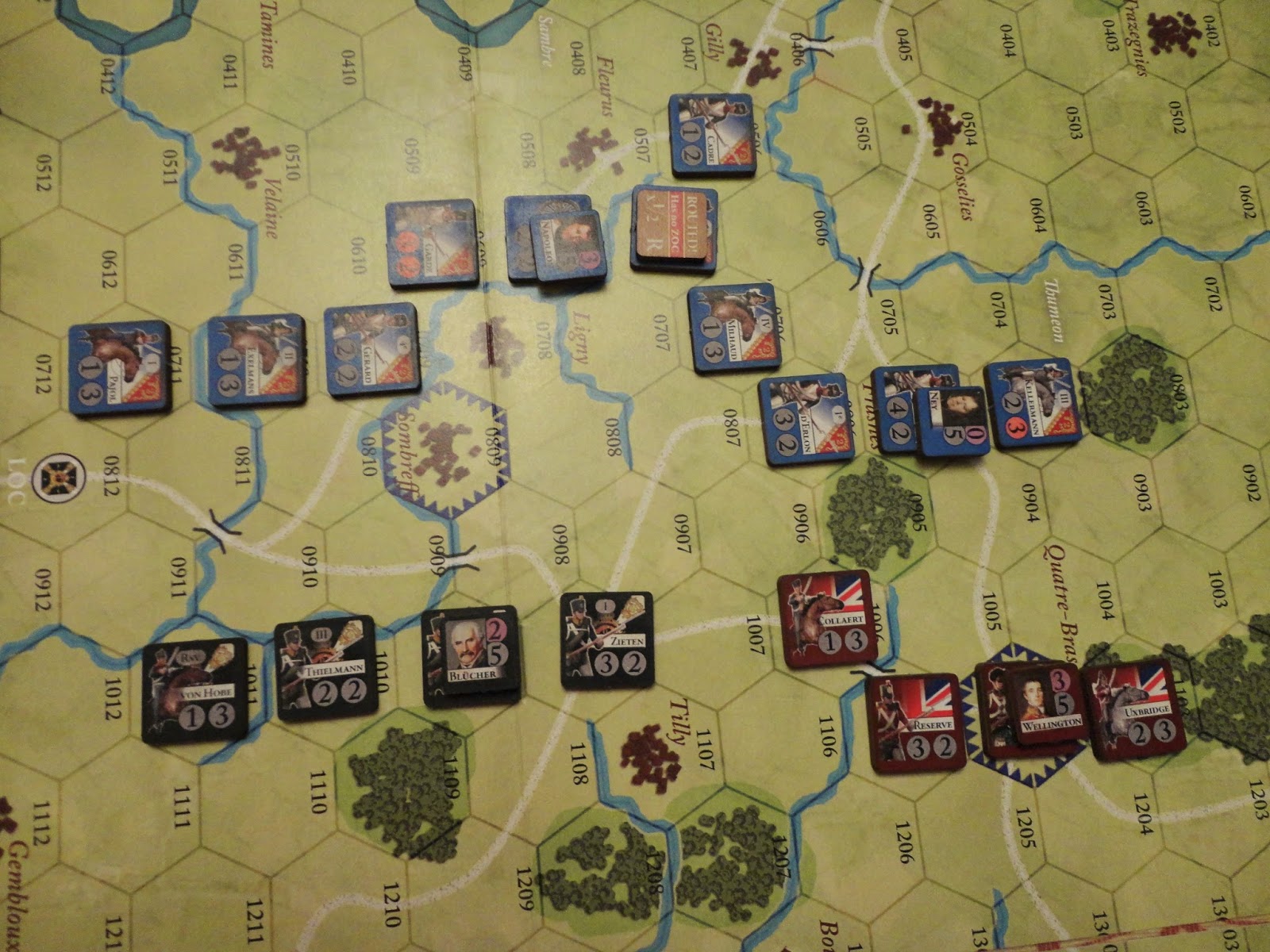
The standard scenario starts on turn 9, the afternoon turn of 16th June, although it is possible to play other scenarios starting earlier than this. This is the opening position of the standard scenario. The Prussians are set up around Ligny with the French massed ready for battle - two units are already engaged. Around Quatre Bras the British and French are both sparsely deployed.

I am playing the Allies and a friend is the French. To note though that these games play very well solo just with the normal rules - I quite enjoy the odd solo game and not just to learn the game.


This is the position after the first French turn. The French go first and as such do not draw an event card. No morale was used to force march or commit the French Guard.


French 3e attacks Prussian 1st corps at minus 1 odds (both strength 3 but across a stream). The French put in a morale point to increase the odds but I put one in too to bring it back to minus 1. The French roll a one and rout but only 1 hex so no morale loss.

The attack of French 4e on Prussian 2nd corps is at minus 2 and again the French put in a morale to improve the odds but I don't this time. With a six though the Prussians need to withdraw.


On my turn I pull the Prussians back into a defensive line and bring up the British to defend around Quatre Bras.

My event card means Fredrick's corps may arrive. I don't toll a six so the variable reinforcement moves on to the next turn to try again.


On to dusk of the 16th June. It is light rain so all infantry have one less strength (attack or defence). The French event is a good one - they can either commit the guard for free or force march all units for free (no units to rally so that is not a useful option). As the French intend to both force march and commit the guard then the card means that this only costs them one morale point for both actions.


The French move up for an all out assault on the Prussians but don't yet move to contact the British.


I realise I made a mistake where I put the Prussian cavalry - with a stream behind their retreat path is a hazardous retreat. I should have put then in 1110 or 1111. I still decide to use my reaction move to charge the guns. They would be doubled when attacking plus the infantry are reduced in strength so a healthy attack. When I counter charge (selective attack on one unit) my strength is doubled to I am at minus 1. I am hoping to push the guns away but I roll low and get a withdrawal but the cavalry break when retreating across the stream and are removed for later rallying (if I had let the French cavalry attack me they could have advanced after combat so on the whole I am still better off).

The French 3e unit gets a no result while 4e and the guard rout the Prussian 2nd corps sat with Blucher. Fortunately I roll a 2 for rout and so no morale loss (you lose a morale if the rout is more than the unit's movement points). Prussian defences looking rather sad now!


On my turn I draw the event which allows me to add a good ground marker - not the best thing I could have gotten at this stage. I stick it on the British unit to the left of Quatre Bras and choose the +1 defence rather than protection from artillery. I roll for Frederick again and again fail to get them.


Two of my Prussians were left engaged after the French turn and long story short they both routed, but again I rolled low for rout and no morale loss. Although apart from 4th corps that has just arrived all the Prussians are routing.


Evening of the 16th June - no rain. The French draw an unhelpful event card but then realise that everyone can get where they need to be with one less on movement - drat!


I realised after that I had forgotten to take a picture after the French move and before the combat. 1st corps routed again - but again my luck held out and only by one hex. On the far left the two French cavalry and the artillery attacked the Prussian 3rd corps but rolled an exchange! Quite a choice for the French, lose both cavalry or the artillery. He chose to lose the cavalry which I thought was the right choice but it did limit the extent to which the Prussian flank can be threatened - however, having checked though my general article again before publishing this I remember now that by taking two units as the loss the French would have lost one more morale and the allies gained one more morale, whereas losing the artillery would have meant a net change of nothing on morale. If we had remembered then he may have taken the artillery as he could not afford to lose another morale or perhaps not and then a later combat could not have the bonus?


Not very useful event again for me - didn't see anything that was helpful.


The Prussians have one unit recovered from rout - the other is still in rout until the end of my turn, the rout marker had not yet been changed in the picture on the French turn (you place the colour of the other player in your turn so that routs come off at the end of the next player turn).


I move up the British cavalry to try and help the routing Prussians push the French cavalry away - night next turn so having the allied units staying there stops the French moving closer during the night (can't enter ZOC, and the rout comes off this turn so the Prussians regain their ZOC). The French are forced to withdraw and have to go back two hexes as they can't stack.


No interesting event cards during night. The French move a few rear units up but can't move further forward. The  British cavalry and Prussian 1st corps then pull back over the stream.

During the night the French lose one morale as the allies hold Quatre Bras then gain one due to rest (they lose it first and that put them to one morale and then increases back to two - so if the French had been on one morale to start with they would have lost before gaining the morale due to rest). The French rally one cavalry but the other is destroyed - the rallied one comes on right at the back.

The allies gain two morale due to rest but spend one to improve rally chances. All three allied units rally (one Prussian cavalry started in the rally box at the start of the game). But with only two lines of communication (LOC) hexes only two can be brought on.

Morale levels for the next day are two for the French and three for the allies. The difficult positions mean that morale gets spent in combat more often than many games. While the Prussians were pushed back they did not really crack and the British were undisturbed and the two armies are still more or less in touch. All still to do for the French.


Morning of 17th June is sunny but the French need to move up to get into a position to attack across a wide front and don't have spare morale to force march. The allies just move some Prussians up and switch round the two British cavalry. Neither side draws an event of any consequence.


Mid day of the 17th and it is light rain and all infantry reduce strength by one. Event cards are shuffled in at the end of night. The French draw their card - oh, no, not that again! The French get to commit the guard for free.


I forget that all infantry are reduced in strength so I think the French attacks are better than they are and so again choose to counter charge in the reaction phase. But again fail and withdraw (safely this time!).


Doesn't look good but then I remember it is light rain. This is worse for the French as they lose more as each unit is affected. The Prussians are in a village so still have 3 strength. The French have four (one for the cavalry, unaffected by rain, and one for 4e and two for the guard). Plus 1 is not terrible but also not great, particularly because if the guard can not advance the French lose a morale (don't have to advance just need to be able to). The French go for broke and put in a morale to push things up to plus 2, I spend a morale to bring it back down (if the French had not put one in I would still have done so and that would have pushed the odds down to zero and increased the chances of a rout as well as a guard recule).

The French roll a 2 and lose a morale as the guard are held. I win! (NB Frederick never made an appearance).


Conclusions

This Waterloo game is actually the third edition of the game. I have the first edition too but not the second. It is essentially the same but the new version has some extra chrome and some more map space. Plays fairly similarly as far as I can see from one game. In the first edition I would always commit two morale on turn one to get the French to force march and commit the guard and put in a big attack on the Prussians. Seeing how this went I still think that is the right strategy - the French actually spent two morale on the first turn to stop the two combats being too bad so may as well of just gone for it. I think with this it is essential to push the Prussians back quickly to make the British position untenable otherwise it becomes a slugfest. 

This game was a good illustration of the use of morale points as we used them so much - and hardly had anything that reduced them due to combat (just my cavalry breaking when retreating over the stream and the last throw of the game when the guard were held).  You can get too aggressive with morale and once you are down around two or three then a couple of bad routs and the game is pretty much over. It also shows that a big push with a couple of morale is likely better than gradually whittling them away boosting individual combats.

This game could still have gone very differently. I rolled terribly on all combats - don't think I rolled above a 3 all game except for my rally rolls in the night. But I also rolled one or two whenever I had a unit routing and hence I never lost a morale due to a rout. If I had rolled higher not only would my units be retreating further my morale would have been reducing and I would have had to fall back with everything to get away from the French to recover.

This third edition has the new components and so better quality than the original I have - not that that was ever a big problem - but there are some nice new bits of chrome that just add a little bit of flavour without complicating or skewing the game. There are more scenario options too and weather can be fixed or variable and like all the Napoleonic 20 games you can chose to play concealed (with dummy units too) or open. Combined with the variability created by the event cards these games are hugely re-playable. 

So I enjoyed the game and would recommend it. If you are interested in these sorts of games I would also suggest getting several as they vary so much with some being set piece battles and others being fluid manoeuvre games and often parts of battles moving form one type to another.


Victory Point Napoleonic 20 series - system review

I have been playing these games for a while ever since I accidentally found out they existed. They are small, quick and fun and with the adaptions to the sorts of rules you would have seen for these type of games back in the 1970s and 1980s they are incredibly re-playable. I thought I would do an overview first so that any review of a particular game could focus on what that game is like and just refer back to this post for a general overview of the game system.

I played SPI and other games back in the 1970s onwards and they did various quad games including for Napoleonic. They were simple but a very predicable game and basically after you had worked out the best initial moves it all went along in the same old way and just depended on the rolls on the combat results table (CRT) - i.e. it was all down to whether you could cut off and kill defenders by surrounding after advance after combat from earlier attacks or you ended up getting yourself surrounded because some later attacks failed.

There are a number of elements that make this system different:

The combat results table - CRT

It does not look that different from those early games on first look but the differences are quite profound, particularly as there are interactions with other parts of the rules. The traditional CRT had a mix of defender or attacker retreat (DR and AR), exchange (EX) and defender or attacker eliminated (DE and AE) results with a few 'no results' on some odds columns. The CRT columns for the Napoleonic 20 series are strength point differentials though rather than odds (mostly odds in older games). That works better as no rounding or wasted points.

The first change is that there are now two types of retreat - withdrawal and rout (DW, DR, AW and AR). A withdrawal is just like a traditional retreat result - fall back one hex. A rout is a more uncontrolled retreat and the length of the retreat is rolled for on a D6 with some modifiers to reduce the roll (e.g. in a fort or an elite unit and if the modified roll is zero or less then it stays put, if it is one then it is a withdrawal rather than a rout). The unit then goes back that far and gets a rout maker that removes the zone of control and halves the combat value -marker is removed at the end of the next players combat phase. If the rout length is greater than the unit's movement points then the army loses one morale - morale is key to the game as described later.

Next, retreating through a zone of control is not an automatic elimination but is a 'hazardous retreat' and has a 50/50 chance of the unit breaking (removed from the map for potential rally during a night turn). If a unit does break then that side lose one morale point but the other gains a morale (a routing unit that then breaks due to hazardous retreat just means losing a single morale point though).

Defender or Attacker break results (DB and AB) are essentially just like DE or AE results except that there is an immediate morale impact and the ability to rally during night turns. On a break result the losing side has their morale reduced by one and the winner get an increase in morale of one. So breaking and routing units is the way to win by reducing the opposing army morale to zero.

Exchange is just like the traditional games - kill the defender and at least as many attacker strength points (possibly in more than one unit). The difference is that the destroyed units break (and can then rally at night) and causes morale changes. Net result is actually all morale goes back to where it started if the exchange means the same number of units go on each side (best to avoid losing two for one!), but the effects apply to the defender first. So if each side loses one unit then the defender morale goes down one and the attacker's up one, if this does not put the defending army to zero and hence a game loss then the attacker loses one morale and the defender gains one.

Terrain effects are always adjustments to strength points not odds (as the CRT does not use odds but strength point differentials). Also they are not cumulative, you just get the best one - so defending over a stream in a town is no different than defending in a clear hex behind a stream. Defending in a fortified position behind a stream is just like defending in a fortified position without a stream. Streams and bridges/ fords over major rivers count as a hazardous retreat. This means taking a position behind a stream is a risky proposition - if you get pushed back after initial successes then it is back over the stream and a potential for the retreating unit to break.

Morale

Those traditional games either had nothing on army morale or a fairly crude army break point based on the number of strength points eliminated (or sometimes individual corps break points). Some games (such as OSG Leipzig - mine is the later Clash of Arms version) then have the potential to rally at a reduced strength. For Napoleonic 20 games, Morale is really the driving concept for how the game works.

Each army has a morale track from 0 to 10 (usually it is between 6 and 8 at the start of a game depending on the particular game and each side may start off at different points). You can't go over 10 and you lose if it goes to zero. Certain events change morale levels and you can also 'spend' them. This last part of the game is what makes it really interesting.

Things that change morale

  • routing more than the units movement, morale down one;
  • unit breaks, morale down one and opponent gains one morale;
  • a guard unit couldn't advance after an attack, morale down one;
  • some card events;
  • if morale low enough and no activity in a turn (a' lull') then can gain back one morale point;
  • during night having one of your objective hexes occupied by the enemy;
  • during night having two or more Line of Communication points (LOC) enemy controlled;
  • gain one due to rest at night.

Things you can spend morale on

  • a forced march - spending one point (at most) to give all units plus one movement this turn;
  • local commitment of reserves - spending one morale (at most) in a battle to add one strength point. Attacker decides first then the defender;
  • to commit a guard unit (there are differences between elites that get various benefits and guards that get them too but have the commitment rules). Committing means being able to move into a zone of control. If your army morale is one then you can commit the guard for free - but also if your opponent's morale is one you can commit your guard for free too;
  • to add one to a roll to rally a unit during night turns.

I have played a number of games when one side is well ahead on morale and the other side close to zero. But it can then often be tricky to force a result in a combat as usually less units around (and a very low unit density to start with) and hence less options. The temptation is often to add a morale point in combat to increase the differential and try to get a good result - ideally to break a unit. But it can never be guaranteed and if you are too cavalier with your morale point advantage you can suddenly find you are not that far off zero yourself and the result of the battle can then but much more in question that you would like! I remember doing that in a game of Smolensk. Very few Russians on the board to start with and my son was a bit too aggressive and got them wiped out. The French had to get themselves over the river and so this slowed them down as Russians gradually arrived on the far map edge. By trying to force a result before too many Russians arrived it ended up being really close and I only just squeaked home in the end.

Cards

Other than the first player turn of a game the first thing you do on your turn is to pick an event card. Each card either has a general event or two different ones - that each apply to a particular side and hence a single card can do different things depending on who picked it. Often cards depend on some condition that may not be met and hence nothing happens. Some are literally no effect for one side and then force a reshuffle of the cards (bringing the discard pile back in the deck). Some cards are specific to the battle, here are a few examples:

  • Lannes dying at Aspern-Essling and boosting the effectiveness of his Corp;
  • Weather effects such as at Dresden;
  • Reduction in movement for one side (e.g. something about the battle meant one side was a bit tardy);
  • you can't enter zones of control in the turn;
  • you can pick an enemy unit and it can't move or sometimes not enter zones of control. 

Others appear in many games, such as:

  • free morale point to spend on forced march or in a combat;
  • one unit get a movement point and strength point increase just for that turn;
  • ability to look at a unrevealed unit if fog of war optional rules used (no effect if not using them);
  • a dice roll to get an effect, often low bad, middling no effect high good (e.g. good may be gain a morale, bad may be that you can't force march this turn).

Even if the effect of events are the same in different games then the name of the event and perhaps flavour text set the scene around events in the actual battle.

Victory Point provide some examples on the web site for some of the games so here are a few to give a better idea (in each case click on next to see the other card examples available):


You can browse the Napoleonic 20 product page to see all the games and other examples of cards and components too.

The cards mostly provide a minor change but can potentially help swing a single combat or can disrupt things to delay your plans for a turn, or may just change what you do that turn a little bit. While a game will not be won or lost as a result of a card (losing a morale point might if you are down to one but then you are on the verge anyway and you are in that position as a result of a whole load of things), it does mean that there is an extra level of unpredictability so that games will always be a bit different.

Other rules

The above three things are why I think this system is different from previous simple games and why it works so well. There are lots of other nice bits in the rules too and there have been 4 versions which always add a few bits as well as clarifying. I won't go through it all but here is just a list of some of the other

  • cavalry retreat before combat or counter attack;
  • light infantry that can act like cavalry on retreat before combat (these are just the key units like the British light divisions not all light troops);
  • unreliable units - may lose a strength point in a combat, roll for it after all other adjustments (e.g. Saxons in 1813, some Spanish in the Peninsular);
  • elite units, less likely to retreat and may gain a strength pint on an 'Elan' roll;
  • optional rules like fog or war - units shown with their national flag until close enough to be revealed.

There are also special rules for each game that reflect the particular circumstances of the battle. While winning is about getting the enemy to zero morale the special rules will often have particular ways to get a minor victory.

Things will be a lot clearer when I review an actual game and when there are pictures of a game board etc. but I wanted to do this general overview to refer back to each time rather than cluttering a specific game review with observations on the standard system. Victory Point put copies of the rules on their web site and you can check out their latest standard rules version there.

The scenario

Finally, not something about the rules but the design of the game.

While most early games (and some new attempts I have seen in S&T magazine which I have not liked either) focus on the final battle (from when the attacks first began to when the set piece engagement ended), the Napoleonic 20 series each cover a number of days, typically 2 to 4. This means you get a map that covers the area around the set piece engagement not just the final battlefield. For example, Waterloo 20 is actually Quatre Bras, Ligny, Wavre and Waterloo all on one map. But all the games basically cover the movement up to the engagement so you can  choose to do it a bit differently.

The game system is called '20' because there are less than 20 units on the board. This low density combined with maps covering a wider area around the actual battle really emphasize the importance of maneuver. Some games are still mainly about set piece combat but others are much more about maneuver and getting the advantage in position.


Conclusions

I have played many board games of the Napoleonic wars. I have not found any games covering the whole war to be any good (e.g. Avalon Hill War and Peace was dire, and although it had some nice features I did not like the combat system in the later Empires in Arms at all. The GTD games were OK but a bit random on the combat but being quick kept my interest for a little while). I eventually gave up trying to find something on the war - I think you are better off with computer games to be honest, if you fancy putting in a lot of time that is.

Games of individual battles though have a variety of systems and different complexities and I have enjoyed many over the years. The most complex was Marshal Enterprises (later Clash of Arms) and it did work well and once you got to know the rules it played reasonably smoothly (nice colourful counters too). But they take quite a while to play and if you are also a figures gamer then the real question is why bother? Other systems have been less complex but still take up quite a while or just don't feel right and many games in recent years seem to be poorly play tested (TSR and S&T games especially). As I have got into Euro style games I have become less tolerant of the more traditional board war games that take hours to set up and play and focus more on moving counters about than they do on the decisions the generals need to make. As described above the simpler games were not that great.

So when I came across Victory Point there was quite a backlog of disappointment and fatigue to overcome. I was then very pleasantly surprised that they are so good and have a high level of replay-ability. The main positives I found were:
  • simple rules but some nice enhancements that add to the flavour and reduce the dependence on individual dice rolls;
  • quick to play;
  • fun games that are almost always very close;
  • cards that added variation to every game;
  • low counter density that adds to the speed of play but emphasizes the importance of maneuver in games;
  • large range and ever expanding;
  • initially cost was very good price. The component quality has been improved over the years and now come in boxes so less cheap but still really good value, particularly when you know what a good game is in the box.

I don't really have any down sides. Others may also like a more complex challenge and a bigger game with more counters and rules complexity but if I want that then I will play miniatures and not a board game - but that is a personal thing that not everyone will share the same view. But whether you are an out and out board gamer or a figures gamer that will play board games then I think Napoleonic 20 series will be an enjoyable experience.


Keep an eye out on my blog as I will gradually do reviews of each of the games in the Napoleonic 20 series.

Sunday, 18 October 2015

My latest Kickstarter activity: board games

Update on my Kickstarter activity since my previous post.

Well, I ended up backing both Gloomhaven and The Others: 7 Sins. Very different Kickstarter experiences.

For Gloomhaven it was all about getting a game developed and stretch goals that improved the content and quality as the funding increased. Not an exiting experience as a Kickstarter but the game looks good and despite not being quite the sort of thing I normally like I just liked the various mechanics too much and having Isaac Childres' first game I know I like the way his games play.

For The Others: 7 Sins a totally different approach and experience. It was quite obvious that the game would have been made anyway and had been pretty much developed. The stretch goals were all about adding extra things like expansion boxes that will be sold separately and some exclusive things rather than adding to the core game. Lots of add-ons too; while cheaper than retail, not by much and adds a lot to the overall cost - you don't have to buy but just too tempting! So the basic pledge of $100 was worth about £305 retail. I have not liked Kickstarter projects with lots of add-ons but not too many here just not cheap and all expansions and so add to the game possibilities. It was quite an experience in itself seeing new stretch goals appear and the basic pledge increase and increase.

I have since backed a few other things, currently live - all a bit more like Gloomhaven in terms of the Kickstarter experience i.e. it is all about getting the game out and enhancing it.

A cheap filler game that looks really interesting: Kodama


A cracking looking game from Jamey Stegmaier: Scythe


And finally one that I have thought about as not exactly what I am looking for but looks a really well crafted game in terms of how it plays (and looks nice): 7th Continent


The only problem now is that the first of all these games is at least 6 months before I get my hands on it! I guess if I back things regularly though that things will start arriving regularly but to do that I would need to shift my game buying to be mainly Kickstarter and not sure yet I want to do that.

Monday, 28 September 2015

Some thoughts on backing Kickstarter games

I did a post on my very first foray into crowd funding not long after I started the blog - mainly just to highlight what looked like an interesting game. That was Historia. When the game arrived I was a bit surprised by the small amount of material in the box (given most games these days seem to be overflowing with stuff) but the game itself was certainly interesting and I have enjoyed playing but was it worth getting via Kickstarter rather than waiting for it to be in the shops? Here are my thoughts:

  • I got the game a few weeks after it was available in the shops;
  • It was cheaper in the shops than I paid for it on Kickstarter - and I paid 6 months in advance;
  • I did get a small amount of bonus material only available separately when sold in retail. But it was not much and I haven't actually been sufficiently enthused by it to play the game with it as yet;
  • Communication was not that great following the close of the campaign - although not non existent and after reading some comments on some other Kickstarter campaigns it seems that some of the main manufacturers are pretty bad on the communication side of things so could be worse!
[as an aside, while available on Kickstarter and the German equivalent I actually pledged via Giochi starter although the experience is actually down to the company and not the crowd funding website].

So all in all I was not that inspired by the whole experience and as a result unlikely to try crowd funding again. Other than the fact I already did just a month after pledging to Historia and hence before getting the full experience! That was Forge War. Truly excellent game and a box crammed full of stuff, although be warned it is a heavier game and takes a good 3 hours or so with the full game (but there are also quicker play options included). But as far as the Kickstarter experience went, here are my thoughts on that one:
  • I got the game before it was in the shops;
  • It was actually a bit cheaper than retail;
  • The stretch goals were many and seemed designed on significantly improving the content and quality of the final game (never seen a better quality box which was one of the goals). So all in all it felt like you were doing what Kickstarter is about and allowing a game to be funded and improved by upfront investment;
  • The designer - Isaac Childres - was doing his first game and was clearly very enthusiastic about the whole thing and communicated constantly, both via the Kickstarter pages when live and then through weekly (at least) emails once it was funded. When there were a few problems with fulfilment he was keeping everyone updated on the issue and progress.
So a very different and very positive experience - left me with the view that steer well clear of big companies as they are just after cash-flow and take a close look at games from people new to the market if they are your sort of thing.

I am now actually contemplating a couple of other Kickstarter campaigns.  The first is the second game from Isaac Childres. That is "a board game of cooperative card-driven tactical combat in a persistent, ever-changing campaign world. 1-4 players, 30 min. per player" called Gloomhaven. I am torn on this one, while I have played games involving character development I am not totally sure this is my thing but then Isaac does make excellent games (well one of one so far) and Gloomhaven looks no exception. I really like the card driven combat and the fact that you lose cards during a scenario so the choices are therefore hard and you need to plan properly. It only has a couple of days left so I will need to make my mind up soon. It looks good value so I suspect I will succumb and back it.

The second involves more established designers and involves an established company that seems to have attracted some negative comments in the comment section for past Kickstarter campaigns. This game is The Others: 7 Sins. This has just over a week to run so I have more time to decide (or procrastinate). This is also a cooperative game with various characters but is not built around character development but rather multiple types of bad guys and maps to give huge variety to each scenario. They actually say on the campaign page that it is likely to arrive after it is available in the shops, but some of the stretch goals seem to be Kickstarter (or future promo) exclusives but more importantly include things that are going to be available as extras (supplements) rather than in the core box - e.g.the extra Sins beyond the 2 in the main box. So it seems that given it is heavily backed (5,630 at the time of writing) you will get a lot more for you Kickstarter pledge than the core retail game. Still undecided but sorely tempted.

I have seen table top wargaming equipment on Kickstarter such as terrain (e.g. trenches). So far though these have not been in my scales and to be honest not things I have ever found problems getting in retail so not been temped by anything other than board games as yet.

I am currently a bit unwell and had enough nap time for now so thought I would distract myself with a blog post. Hope some of you find it of use.

Thursday, 13 August 2015

Quartermaster General WW2 board game - a review

A recent acquisition. Something I have been looking to get and just waiting until I was ready to order a few other things. I played with a friend on the weekend and hence as a two player game I was the Axis and he was the Allies. You can play up to six with individual countries or groups as specified for the number of players. There are only victory points though for each team and hence one team wins not individual countries.

This is a review rather than a strategy guide aimed at showing how the game works and my views of the game. As a first play I am sure we did not play an optimal game by any means!

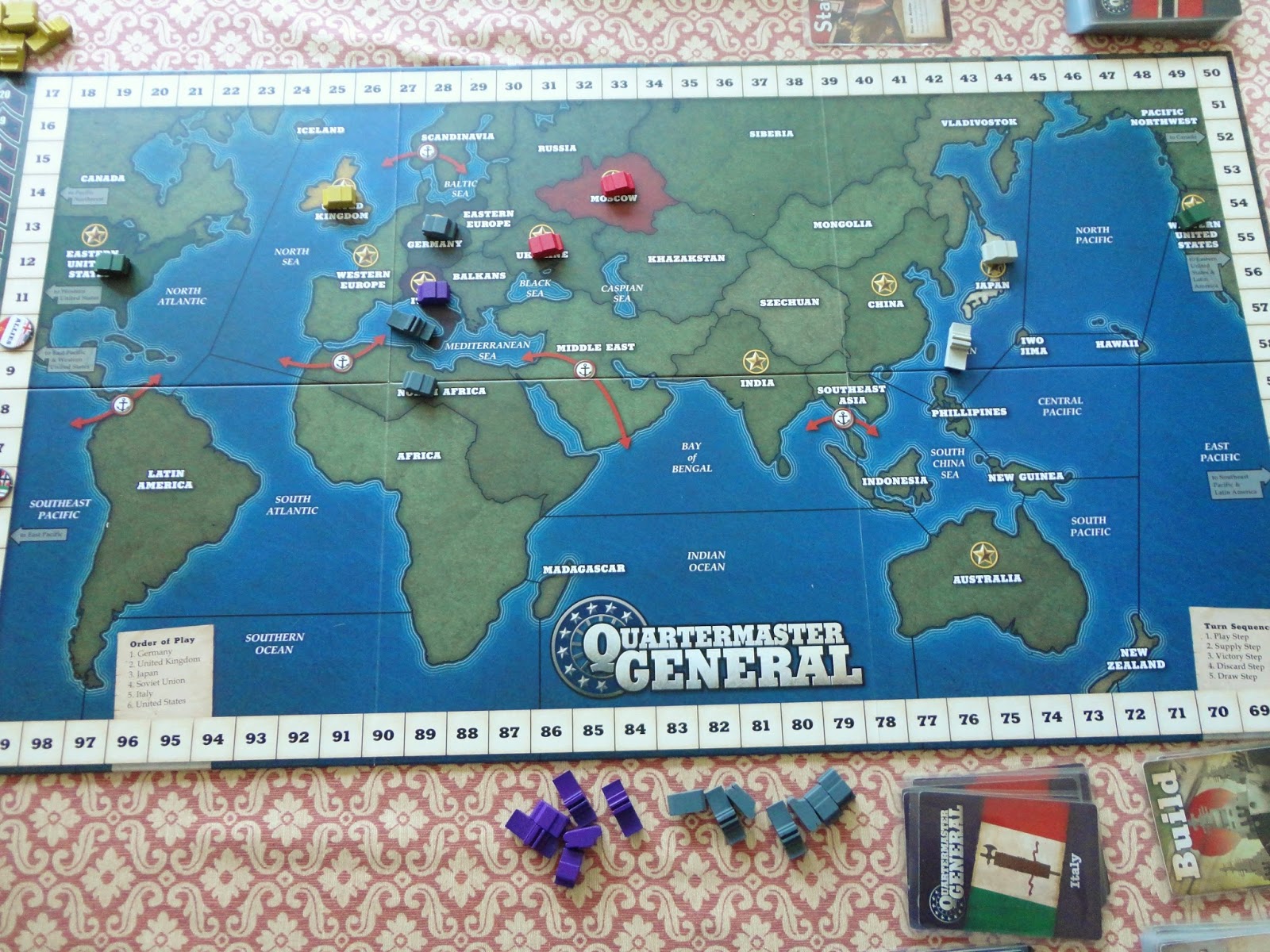
Here is the board and the initial set up with each country just having an army in their home area:


Overview

I will now give a brief overview of the rules and then play through the first couple of turns in full then skip ahead to the heavy action later in the game.

Each player has a fixed set of armies and navies:

  • Germany - 7 armies and 3 navies;
  • Britain - 5 armies and 5 navies;
  • Japan - 5 armies and 5 navies;
  • Russian - 7 armies and one navy;
  • Italy - 4 armies and 3 navies;
  • America - 5 armies and 5 navies.

Pieces don't actually move on the board but show control of an area and then become areas from which actions can be taken like an attack or building in adjacent areas (that are not enemy controlled). You can only have one piece in a space but there can also be a piece from anyone else on your team. Mostly actions can only be done from an area if it is supplied - that means tracing a continuous line of areas with your units in back to a supply base. Navy units also need to have a land unit in an adjacent area but that can be a unit from another country on your team (represents an open port). One distinction which is important is that units can be built or with some card effects can be recruited. A build can only be done if the unit would be placed and in supply immediately but with recruiting it can be put on the board regardless of supply. There are examples later on showing why this is important.

The turn order is:

  • Germany
  • Britain
  • Japan
  • Russia
  • Italy
  • America

and a turn consists of the following:

  • Play a card (only one card);
  • Check supply;
  • Collect victory points;
  • Discard cards if you wish;
  • draw back up to seven cards.

Victory points are gained for supply areas (star in a circle) with 2 points for each controlled and then points for some card effects.

The cards

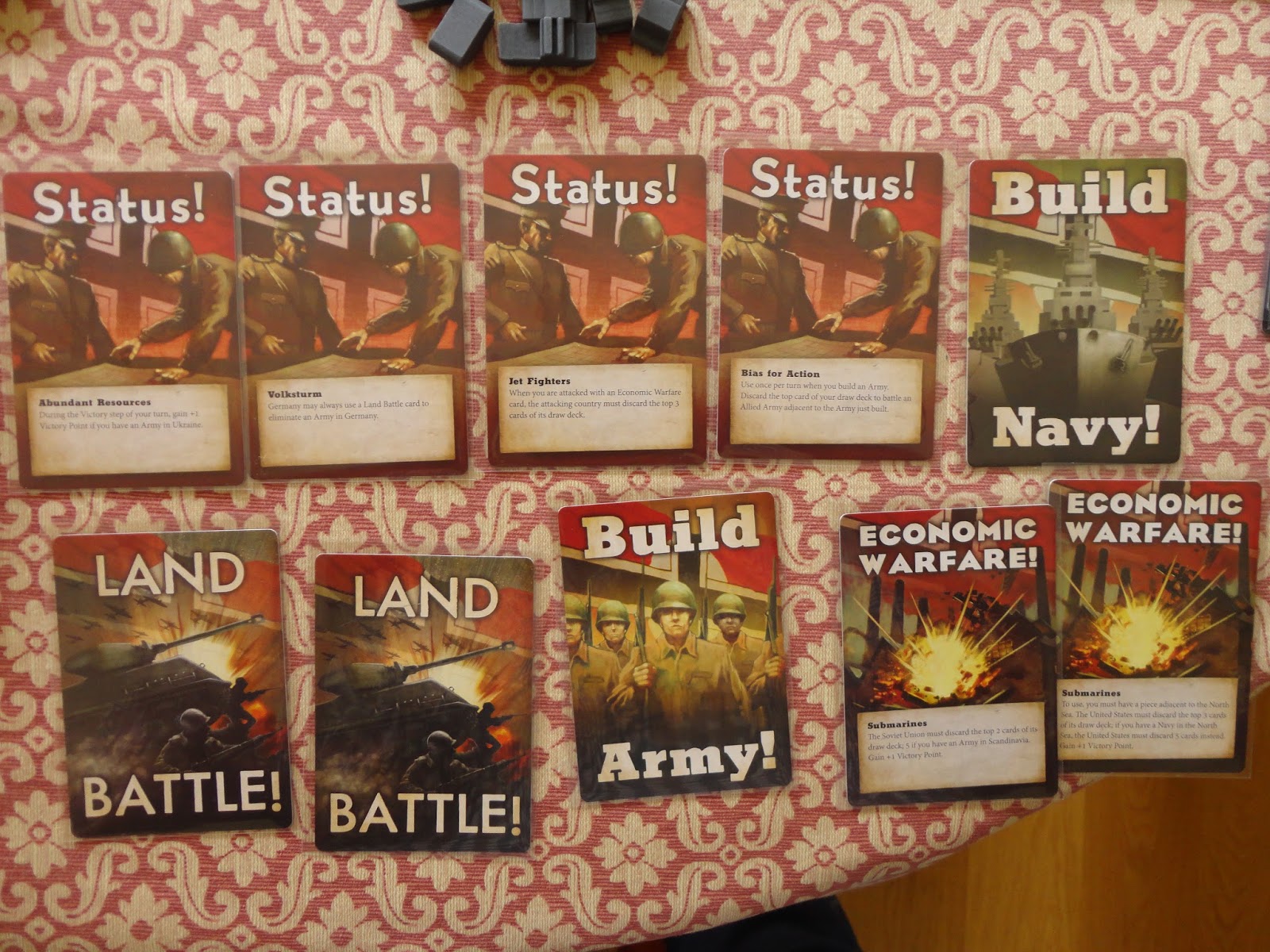
So you can see just from the turn sequence that it is all about card play. As an introduction to the cards let's consider my set up as the Germans. Each player shuffles their country decks and then deals 10 cards for each but has to discard 3 and keep 7 for their starting hand. Her are my first 10 for Germany:


Having not played before I am trying to make a decent choice based on the type of card and the effect and what I think I will be trying to do as my strategy.

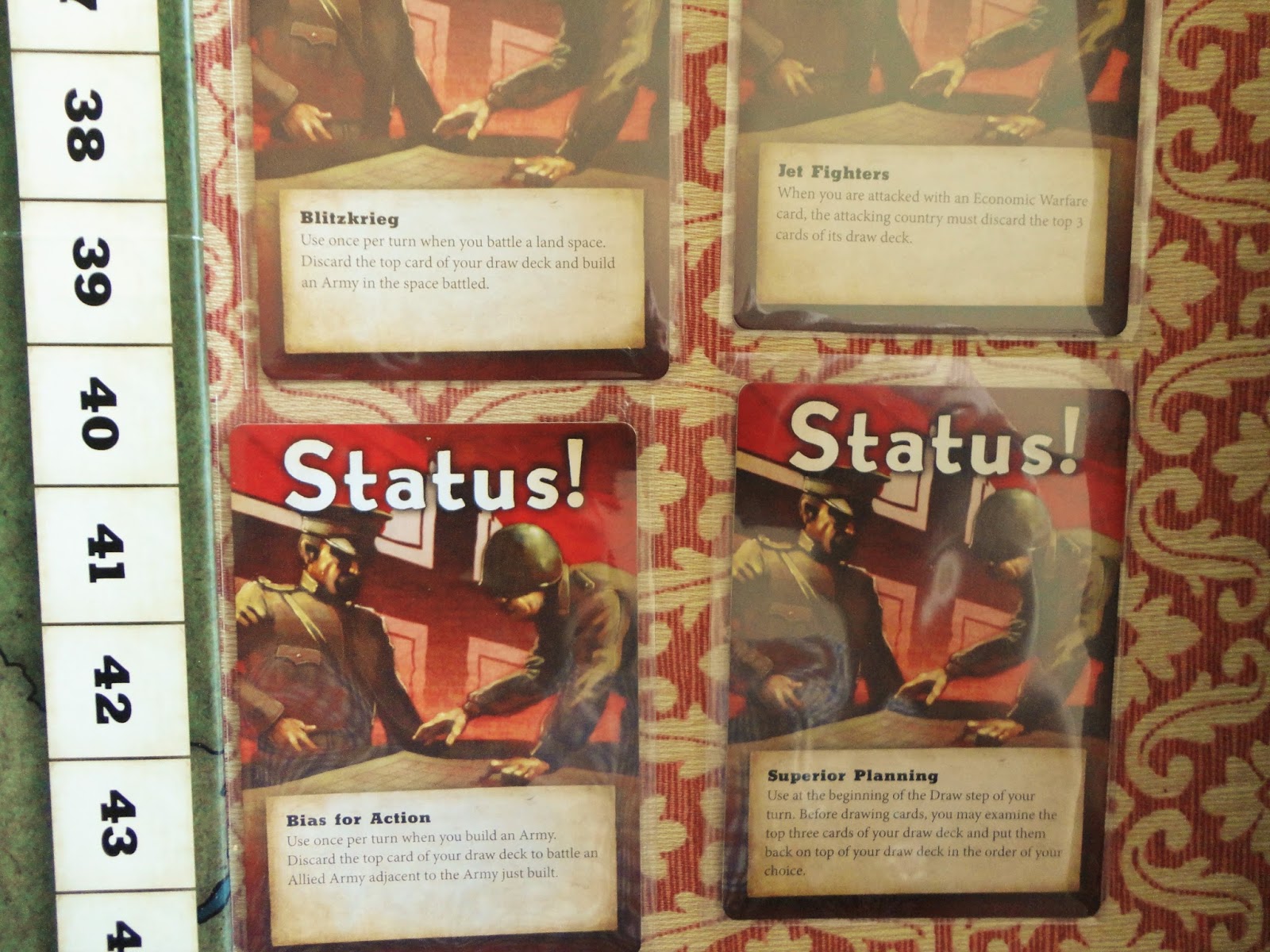
First let's consider the status cards. My opinion is that these are some of the most powerful cards if the ability is a good one that fits in with what you are trying to achieve. The reason for this is that when played they stay face up on the table and the effect is there for the rest of the game - it may be a continuous effect or a triggered ability. Given only one card can be played a turn something that remains to be used is a big increase in what you can do on a turn. If you click on the photos you will get a larger picture and you can read the cards, but in summary I got:

  • Abundant Resources - get a victory point if occupy Ukraine. I didn't think this was sparkling card but kept it anyway as I would definitely be looking to take and hold Ukraine so should come into effect. Actually after the first couple of turns I realised the odd extra victory point a turn can be important to not fall behind assuming an automatic victory does not happen (400 VPs or capture two opposing home areas) - although as it turned out I did not play it as too many other better choices when it came down to it;
  • Volksturm - allows Germany to use a land battle card to take back Germany where otherwise the units would be out of supply and unable to be used to play an attack card. I thought this was a bit defeatist and did not keep;
  • Jet Fighters - puts a penalty back on the opposition if they play an economic warfare card on you. As I was expecting this to be something the Allies would do this seemed a strong card;
  • Bias for Action - when building a unit in an area you can discard the top card from your deck to then attack an adjacent area (attack meaning remove a unit from the adjacent area). This seemed very strong and so a definite keeper.


Germany is quite heavy in status cards by the way which is why they can act like the actual Germans and spread quickly.

I had a couple of economic warfare cards. These allow you to deplete opponent's decks by forcing discards from the top of the draw pile. Not sure at this stage how good this is but knowing various card games and depleting decks being powerful I thought carefully about these. Having decided not to go naval with the Germans I discarded the one against Britain as I would need a fleet but kept the one that targets Russia.


The basic cards that each player has are:

  • Land battle - remove an enemy piece from a land area adjacent to one of your supplied pieces (your piece can be a navy hence amphibious landings);
  • Sea battle - the same but for attacks on a sea area (your piece can be army or navy - I guess attack from a land area is representing air attack?);
  • Build army - put an army piece in a land area, adjacent to one of your pieces, that does not already have one of your pieces, or an enemy piece, and would be in supply when placed;
  • Build navy - as above but navy piece in a sea area.

I decided to keep both land attack and the build army but discard the build navy card. And here is my starting hand.


Just a word on two other card types that did not appear in my starting 10 for Germany:

  • Event cards - these provide a one off result when played and are quite varied in what they do. You will see a few during the course of the play through;
  • Response card - like status cards these are played in front of you to be used later. The difference being they are placed face down so your opponent can't see them. They are also come into play when triggered and then discarded so just a one off. Despite being a one off they are a surprise and can do things like place other pieces or prevent your pieces being removed so quite powerful. Japan has quite a few of these and not may status cards. You will see some examples in the play through.

So on to the first couple of moves which will hopefully make the game mechanic clear.

Turn 1:

Germany places the status card Bias for Action. Essentially getting ready for later turns when a build action will become more powerful. Gains 2 VP.


Britain plays a status card that allows units to be built directly in India. While India is a supply area it only acts as one when a unit is on it and hence initially you would have to trace back to the UK to be in supply without this card. Gains 2 VP.


Japan had a lot of cards for building so built a navy next to Japan first. Gains 2 VP.


Russia builds an army in Ukraine. Gains 4 VP.


Italy play an event card which recruits a German army in North Africa and a navy in the Med. The placement of the units is a recruit not a build which is important as the units would not be in supply - but don't have to be checked until the German turn after card play. A reminder, a built unit has to be in supply when placed a recruited unit does not. Gain 2 VP.


The Americans build and army in the Western US and gain 4 VP.


Map after turn 1:


Turn 2

Germany builds an army in Western Europe. This was not because it was vulnerable to attack - until the British have a navy in the North Sea they can't place armies there. But it was to complete the supply lines for the fleet in the Med and the army in North Africa. It also was a side benefit to stop the Allies getting miles ahead on VPs as two of their countries where gaining 4 VPs a turn. Gain 4 VPs.


Britain builds a navy in the North Sea. Gain 2 VPs.


Japan builds an army in China. Gain 4 VP.


Russian builds an army in Khazakstan - I would probably have gone for Russia personally (keeps it from being adjacent to the Germans but builds up blocks to Moscow). Gain 4 VP.


Italy places down a reaction card - Romanian Reinforcements which you will see later. Gain 2 VP.


The Americans build an army in Latin America - this was to allow a British fleet to be built in the South Atlantic on a later turn. Without the army there would be no port and hence not in supply and can't be built. As it turns out later this was not a great move as the supply line was too vulnerable particularly with the lack of appearance of an American navy. Gain 4 VP.


Skipping forward a bit, things got really interesting on turn 7:

On the German turn an Event card, Broad Front, was played. This allows the Germans to attack up to 3 Russian armies that are adjacent (and attack means remove). There are only 2 adjacent - in Eastern Europe and Ukraine but still a good attack.


By now the Germans have 4 status cards out and 2 are really nice and interact very well: Blitzkrieg which allows a new army to be placed in an area you have just battled and Bias for Action which allows the Germans to battle a new area adjacent to a newly built army. Both require a card to be discarded from the top of the deck. Not only can the playing of a card trigger one of these they then trigger each other and either way round too.


So this is how it all worked out. Broad Front removed the Russian armies in Eastern Europe and Ukraine. Blitzkrieg then kicks in from an attack and I chose the attack on Ukraine (can only do once a turn). That builds a German army in Ukraine and the build then triggers Bias for Action which attacks Moscow and removes the unit (can't trigger Blitzkrieg a second time to occupy it unfortunately!). However, the Russians still have one face down response card which they trigger - Moscow which prevents the removal of an army in Moscow for that turn.


Meanwhile in the Far East the Japanese take the opportunity presented by a lack of a British unit in Australia. In a previous turns the Japanese had put a fleet in the South China Sea and also put face down some response cards, one of which was Destroyer Transport.  The card played for the turn was Sea Battle and it is perfectly legitimate to battle an empty area to trigger effects (the rules specifically state this). So I made a sea attack into South Pacific then used that to trigger Destroyer Transport which allows you to put up to two armies on the board adjacent to the attacked area. I used that to put an army in Australia but decided not to put one in New Guinea as I wanted my limited pool for China and there were no Americans in sight to defend against anyway.


The Italian turn really started in the Russian's turn. The Russians attacked Ukraine to remove the German unit and hence push them back from Moscow. However, the Italians had a response card down which then triggered: Romanian Reinforcements which triggers when a supplied German unit is removed and replaces it with an Italian Army (recruit). At that point the Italian army is not in supply as it can not trace a line of Italian units back to Italy but supply is only checked in your own turn and after card play. Hence, in the Italian turn I played Build Army to put an army in the Balkans to keep the army in supply for the next step when supply is checked.


Turn 8, conquest of Russia:

This is the position at the start of the German turn with no German armies adjacent to the Russians but the Germans doubled up with the Italians in North Africa and the Balkans. So the potential to continue the conquest looks a bit tricky.


However, I have the event card The Autobahn in my hand. That allows me to pick up every German army and build elsewhere (if I so wish). I decide to do that with the army in North Africa and the Balkans and move them to Eastern Europe and Ukraine.


Because the event card does not move the unit but removes and then builds elsewhere the build allows Bias for Action to trigger and for Moscow to be attacked from Ukraine. With the Russians all out of response cards Moscow is cleared and Blitzkrieg can be triggered to build a German Army there.  The Russians no longer have units in supply so the ability to play cards is limited and they get removed in the Russian supply phase.


Before seeing the conclusion of the game a brief look at the American cards. Four status cards are out. One allows the use of the supply base in Szechuan (and hence can build units there not just trace supply), another a second fleet can be built when building one and a similar one for armies and the last one being the ability to bring back a card from the discard pile by discarding 4 from the top of the deck. Other than preventing Japan expanding in China the first did not affect things very much. The extra builds were not much use as the Americans only have 5 army pieces and 3 were already out and having never drawn a build navy card the US fleet didn't make an appearance (a few came up when discarding from the top of the deck but none in hand). The last status card was used a few time to bring back an economic warfare card that forced the discard of 4 cards from the top of the Japanese deck - so just as well they did not need to do anything much once Australia was captured. So all in all the Americans did not really impact on the war. I am not sure if a build navy card was discarded in selecting from the initial 10 cards - I forgot to ask - or it was just horrendous luck that they were discarded for card effects every time one came near the top. Just realised that Flexible Resources could have been used to bring back a build navy card then Superior Shipyards to build a second one - which could have got a fleet into the North Sea in one turn. Whether it would have been enough as the Italians had a second sea battle I don't know but could have made a difference.


End of the War

As the Germans took Moscow, the Italian fleet attacked the British in the North Sea. The Brits had no Response cards to prevent it and the next turn did not have a build navy card to hand to build in the empty sea area. The British navy in the South Atlantic and the army in Africa were removed because of supply. This allowed the Italians to build a navy there on their turn (the British used some affect to destroy a fleet in the Med - can't remember precisely what - but with a German fleet there I could lose that and still have an Italian fleet remaining to ensure I could then build in the North Sea because it would be in supply). The following turn the Germans built a fleet in the North Sea then the turn after attacked the UK and with Blitzkrieg could place a army there so no time for the Brits to build on the empty space (you can always build on your own home area if not occupied). Game over with two enemy home areas occupied on turn 11 (out of max 20).


Conclusions

Excellent game. It is actually a card game with a board rather than the other way round I would say. I don't agree with the assertion in the rules that it is a game of supply. While supply is important you are not doing anything with supply in the game other than ensuring all your units are connected and can trace back to a supply base - and hence and be used for the launch of an attack or to allow a build in an adjacent area etc.  It is more a game of preparation and build up and making the best use of each country's abilities - which are a different mix of status and response cards (mostly status for Germans and mostly response for the Japanese for instance). In this way you get the most benefit from actions like build or attack or blunt your enemy's actions. You also have to accept giving up cards as discards to power many of these benefits - so you need to be sure you are doing something worthwhile as a really good card could be lost. Each action you take should build towards your goals - no point just building units on the board for the sake of it unless it takes your strategy forward. Getting cards that interact well is pretty important too.

Works very well as a two player game. I have not tried other numbers of players but I can't see any issues with any of the possible numbers - even the Italians are good to play having so many supporting cards for the Germans rather than having to do their own thing all the time. With multiple players you still only win as the Allies or Axis so that may not suit some people as there is no individual winner except in the two player game (or possibly the single team in the three player game). However, all player will be doing things that obviously contribute to the win so I suspect it is still a fulfilling experience for all.

It is a relatively quick game and will speed up as you get the hang of the cards and the general strategy. I can see me playing this many times (I also have the expansion Air Marshal but will bring that in later rather than straight way, will just add to ongoing re-playability). Games will certainly improve as the understanding of how cards interact develops as well as finding alternative ways to get things done rather than just the obvious way. But also knowing what it is important to do and when.

A WW2 game that is really about supply is Road to the Rhine which I have and have played as one, two and three player and this is also a good game which I may do a review on at some point.

If you like Napoleonic board games then my review on W1815 me be of interest too.